cat ~/articles/ai-predictions-graded-round-of-16.mdx
Comunio World Cup 2026 · Part 6Two of eight: the AI's worst round of the tournament — and the three very different ways it got there
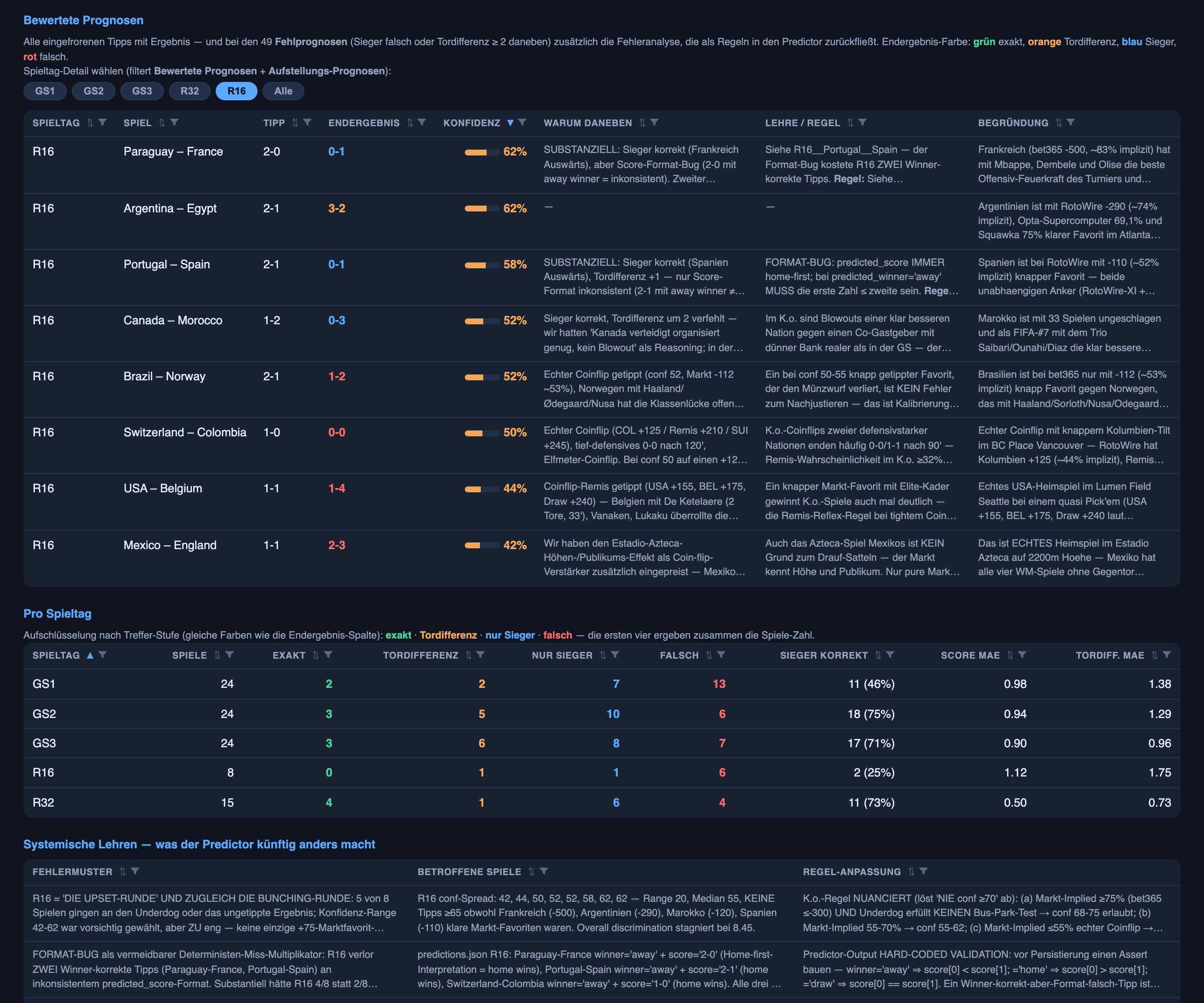
The Round of 16, graded in public: my World Cup fantasy AI called 2 of 8 winners — its worst round yet. Taken apart, the wreckage splits into a clerical bug that cost two correct calls, a safety rule that overshot, and coinflips lost fairly. Meanwhile the quiet half had its best round, and the league lead exploded from five points to fifty-five.
The last article ended with a specific thing to watch for: after the system walked back into its old overconfidence trap, it wrote itself a hard rule — in a knockout, never put more than about seventy percent on a favourite — and I said whether that discipline held was exactly what you’d be able to check on this page.
It held. Not a single tip crossed the line. And the round was still the worst one on the scorecard — by a distance. Two of eight winners called correctly — twenty-five percent. Zero exact scores. The average miss on the final margin, which had improved every single round of the tournament, snapped back to its worst value yet. A rule can hold and the round can still go wrong, and the gap between those two sentences is what this piece is about.
I’ll say the uncomfortable part first, because the whole point of grading yourself in public is that you don’t get to soften the number: the grade is 2 of 8, and it stands. But when I took the round apart, the wreckage sorted into three piles — a clerical bug that cost two correct calls, a safety rule that overshot, and a set of coinflips that were priced honestly and lost anyway. Three different kinds of wrong, three different fixes. Lumping them into one “bad round” would teach exactly the wrong lessons, and pulling them apart is the most useful thing I did all round.
One standing clarification, since new readers join every round: there’s no custom model being trained here. I take existing, off-the-shelf AI models, hand them the tools, the context and a specific job, and sharpen how they do that job round after round — closer to briefing a sharp new analyst than to building a brain.
The headline, both halves of it
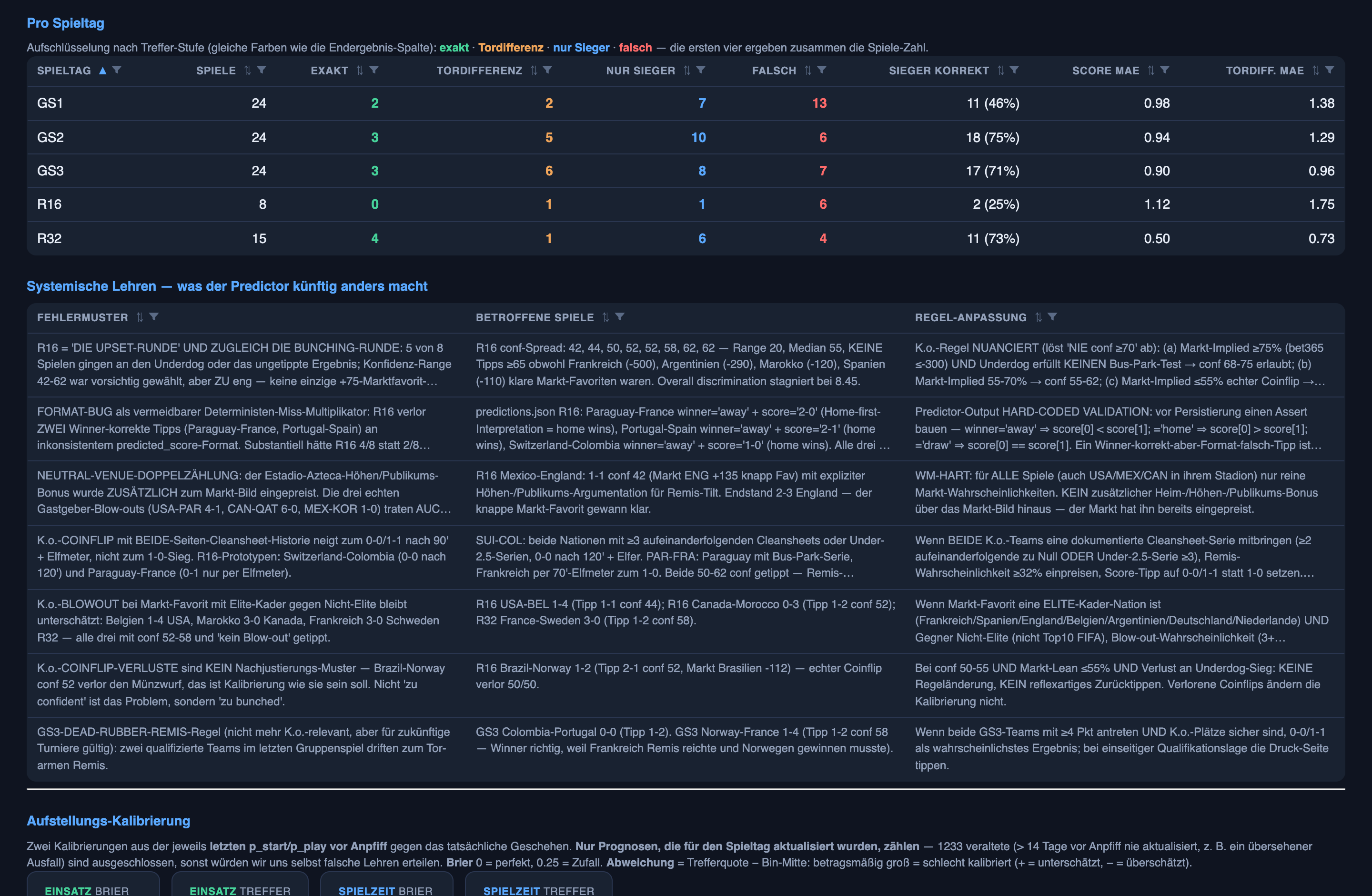
The bad half: the match predictions had their worst round of the tournament. Two of eight winners right, against an arc that read 46% → 75% → 71% → 73% across the previous rounds. No exact scores for the first time. And the goal-difference error — on average, how far the tipped winning margin misses the real one; tip a 2–0 that finishes 5–0 and you’re three goals off — had fallen every round, from 1.38 goals down to 0.73. It jumped to 1.75, its worst value of the whole tournament. Upsets ran through the whole bracket — Brazil going out to Norway the loudest of them — and the system’s own postmortem page calls this “the upset round and the bunching round” in the same sentence; both words will earn their place below. One caveat before any superlative in this piece, and it cuts both ways: a knockout round is eight games. Eight. I attached a direction-not-decimal warning to friendlier numbers on bigger samples in earlier rounds, and it applies double here — to the worst-round label and to every “best” that follows.
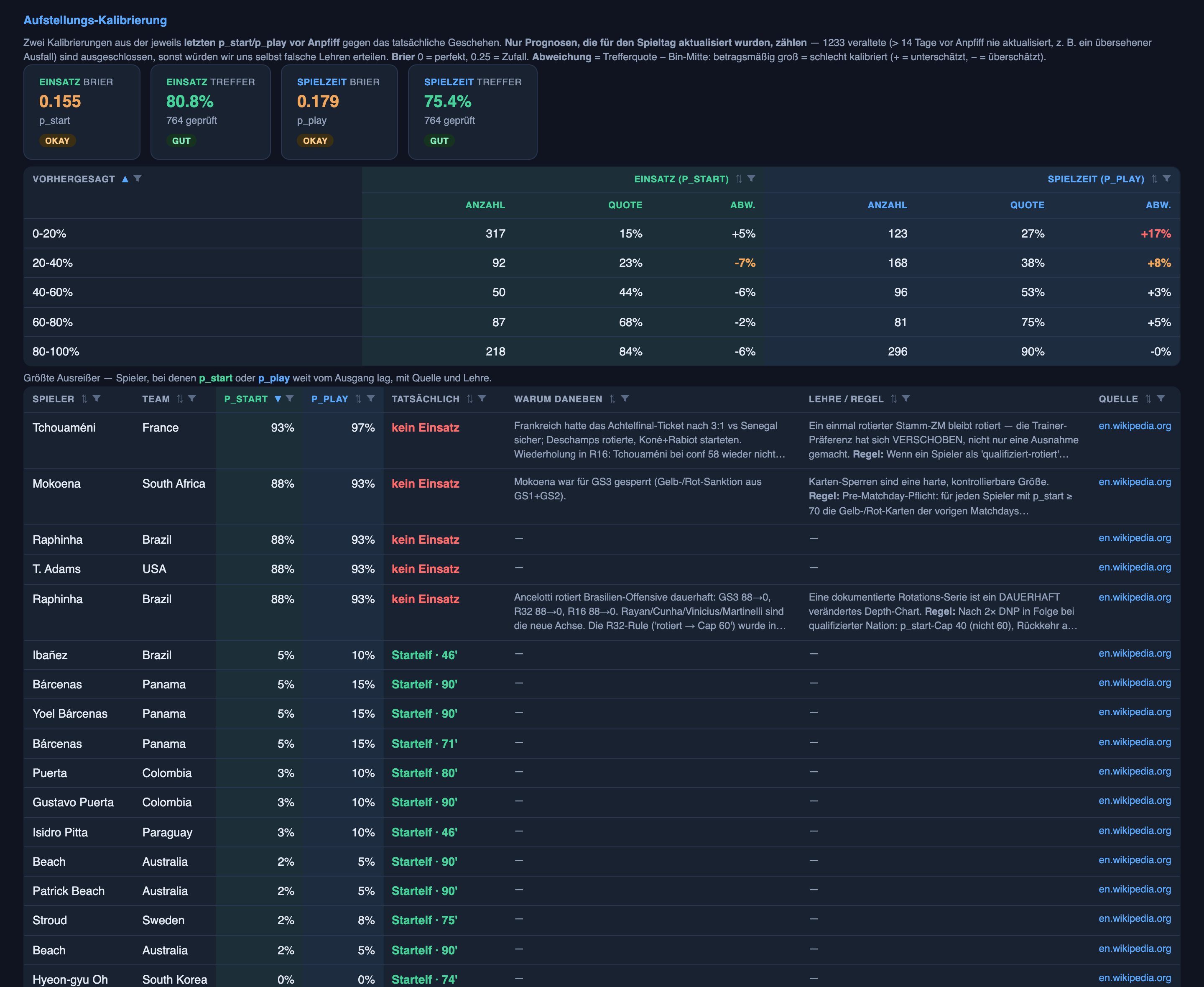
The good half, right alongside it: the quiet part of the system — the one that predicts who actually walks onto the pitch, the part that wins me the league — had its best round of the tournament: right on about 85% of its start calls, on the scoreboard I cleaned two rounds ago and can now actually trust. And the league table moved further in one round than in any round before it. Both halves are real, neither cancels the other — and the gap between them sets up the one line I’d keep from this piece if I could only keep one: the number a stranger would skim first is not the number that pays.
The recap, in case you’re new here
Quick context if you’re new: a squad of AI agents does the daily homework for my team in a fantasy World Cup, calling two things every round — who will actually start each game, and how each game will end. Reality grades both, out loud, and I write up the marks, the misses louder than the hits. The group stage is long over; we’re in the knockouts now, where every game is one-off, a draw goes to penalties, and the points count double. This is the fifth graded round, and the first one where the result predictions genuinely fell on their face.
Way one to be wrong: the answer was right and the record was wrong
Start with the pile that hurts the most, because it was entirely self-inflicted and had nothing to do with football.
The system tipped France to beat Paraguay. France beat Paraguay. It tipped Spain to beat Portugal. Spain beat Portugal. Both of those tips are graded wrong on the scorecard above, and the grade is correct.
Here’s what happened. Every tip has two parts: a winner (“away”) and a scoreline (“2–0”). The convention — the same one every football table in the world uses — is that the score reads home-first: a “2–0” means the home side scored two. In three of its eight tips this round, the system wrote the scoreline from the winner’s point of view instead. “France wins 2–0” came out as Paraguay 2–0 France, away win — a tip that contradicts itself. My grader looks at the scoreline, reads a home win, compares it to the actual away win, and marks the tip wrong. Two of those three self-contradicting tips had the right winner in them; the third, Switzerland–Colombia, was wrong either way. The round’s official 25% would have been 50% without the bug.
If you’ve been reading this series, you’ll notice the pattern with me: two rounds ago I discovered I couldn’t trust my record of who actually played and spent a round cleaning the actuals. The measurement chain has two ends — what really happened, and what you predicted would happen — and the moment I finished scrubbing one end, the bug moved to the other. I fixed the ruler, and then wrote the reading down backwards.
The fix is as dull as the last one, which by now I take as a sign it’s the right kind: a hard validation check inside the predictor itself. Before a tip is allowed to persist, winner and scoreline must agree — “away” means the second number is bigger, “draw” means they’re equal, no exceptions, a violation blocks the tip from being recorded at all. A tip now has to pass the same kind of consistency check an invoice passes before a bank pays it. That rule didn’t exist because it had never been needed: eighty-seven match tips before this round, zero format errors. The system found a brand-new way to be wrong, in the round where being wrong was most expensive.
Way two: the safety rule that overshot
The second pile is the one I find genuinely instructive, because it’s the direct shadow of the previous article.
After the Germany–Paraguay fiasco — a 76%-confident favourite held to a draw and knocked out on penalties — the system wrote itself the hard rule I mentioned: in a knockout, never go above about seventy on a favourite, because the penalty shootout turns every draw into a coin toss and that risk has to live in the number. The rule was born from a real, repeated failure. This round, the rule held perfectly.
And here’s what it did. All eight tips came out between 42 and 62 percent confidence. France — a side the betting market expected to win about five times out of six, the clearest favourite of the round — got tipped at 62. Argentina, whom the market had at roughly three chances in four, got exactly the same 62. A genuine coin-toss game got 52. On the dashboard the whole round sits in one narrow band, everything sounding the same, the way a person mumbles when they’ve been told off for shouting. The system’s own postmortem invented a word for it that I’m keeping: bunching.
Remember the number this series keeps coming back to: confidence discrimination — the gap between how sure the system is on calls it gets right versus calls it gets wrong. A teacher who feels equally unsure grading the best paper in the pile and the worst has stopped telling you anything; a useful forecaster is loud when there’s signal and quiet when there isn’t. The bus-park trap — a favourite tipped to win comfortably against a side that “parks the bus”, football slang for pulling every player back to defend and playing purely not to lose — was the loud-when-wrong failure. Bunching is the opposite failure: never loud at all. If every tip sounds the same, confidence stops carrying information — you couldn’t tell the France call from the coin-toss call by the number attached to it, and this round the target the system set itself (a gap of at least ten percentage points) was missed again: the pooled figure crept up from 7.67 to 8.45. Better, still short.
I want to be precise about what went wrong here, because it isn’t “the rule was bad.” The rule addressed a real failure and it prevented a repeat — no high-confidence favourite got burned this round. What went wrong is that a rule written to cap one specific behaviour quietly became a ceiling on everything, because it’s easier for a system under correction to be uniformly timid than selectively bold. The correction for overconfidence produced underconfidence. If that shape looks familiar from outside football, it should — more on that in the last section.
Way three: the coinflips that were lost fairly — and the draw reflex that wasn’t
The third pile is the subtlest, and it splits in two.
The fair losses first. Brazil–Norway was priced by the market as a near coin-toss — Brazil at about 53%. The system tipped Brazil at 52% confidence and Norway won, Haaland and Ødegaard running straight through the middle of a side whose holding midfield was overrun. The Switzerland–Colombia tip leaned Colombia at 50%; the game finished 0–0 after extra time and went to penalties — an outcome the market itself had at roughly a third.
Neither of those is a modelling error. A 52% call that loses is what 52% means: you lose that call almost half the time, forever. The system’s own postmortem gets this exactly right, and writes a rule I didn’t expect from it: a near-coinflip tip that loses the coinflip triggers no rule change. Overreacting to fair losses is how forecasters ruin themselves — you end up chasing every result backwards, and by the time you’ve “learned” from ten coin tosses you’ve unlearned everything real. After last round, I watched this system overcorrect; watching it now explicitly decline to correct is the most grown-up thing it’s done all tournament.
The unfair losses are a different story. Twice this round the system tipped a draw in a game between a decent side and an elite one — USA–Belgium and Mexico–England — reasoning both games were tight coinflips, so the draw was the safe middle. Belgium won 1–4. England came from behind to win 3–2 in the Azteca. Both “safe” draws were wrong, and wrong in an instructive way: tight odds between an elite squad and a merely good one turned out to mean either could win, not it will stay close. Two games is thin evidence for a law, so that’s logged as a working rule to test, not a truth — but it’s the read both blow-outs point to. And in the Mexico game the system compounded it by hand-adding a bonus for altitude and a hostile crowd on top of the market price — a price that already had England at just +135 against a weaker squad, which is the Azteca discount sitting in plain sight. Counting a famous factor twice isn’t insight, it’s double-entry enthusiasm. Both of these produced new, narrow rules — the draw-as-refuge reflex is capped against elite opponents, and no home-advantage bonus gets added on top of a market price that already contains it.
One more honest note on this pile: Canada–Morocco was called for Morocco — one of the two official hits — but tipped 1–2 when it finished 0–3, and the miss on the margin is part of why the goal-difference error blew out. In a knockout, a clearly better side against a thin bench doesn’t win politely; the system under-tips routs, has done so all tournament so far, and this round it finally cost visible points.
The quiet half had its best round — on the scoreboard I can finally trust
While all of that was going wrong, the other half of the system quietly had its best round of the tournament.
The who-starts model — the one that puts a number from 0 to 100 on every player’s chance of being in the starting eleven, the way a doctor quotes odds before an operation — was right on roughly 85% of its calls this round, its best of the five graded rounds — with the same eight-game grain of salt as every other superlative in this piece. And that number means something now in a way it didn’t before the scoreboard rebuild, because it’s computed on the record I scrubbed after the matchday-three fiasco: every actual sourced against the public match record, stale predictions excluded, suspensions counted. The cleaned scoreboard held. Nothing needed re-scrubbing. The dull work stayed done.
It wasn’t spotless, and the imperfections have a pattern to them: the two players it keeps getting wrong are the two it has already been wrong about before. France’s midfield anchor — my own player, the man whose phantom benching broke my scoreboard two rounds ago — was rotated out again, and the system, having learned “he might be rotated,” still had him too high. And Brazil’s winger has now been rated near-certain to start three rounds running while starting none of them, because the coach didn’t make an exception, he changed his mind permanently. Both produced tightened rules: a regular who’s been left out twice in a row gets capped hard until a coach says otherwise, and a “rotation” that repeats is reclassified as the new normal. The outliers table on my dashboard is, in effect, the place where next round’s apologies are announced in advance — which is exactly what I want a scoreboard to do.
The standings: my worst prediction round was my best league round
Now the part that sounds like it can’t be true.
In the round where my result predictions went 2 of 8, my team had its best round of the tournament: first place, 426 points, fifty-five clear of second. A round ago that lead was five points. The squad value dipped a little — eliminated nations drag the market down — but the value lead over the next squad widened to about fifteen and a half million, and I’m carrying eight players into the quarterfinals, having added one defender from a team still alive.
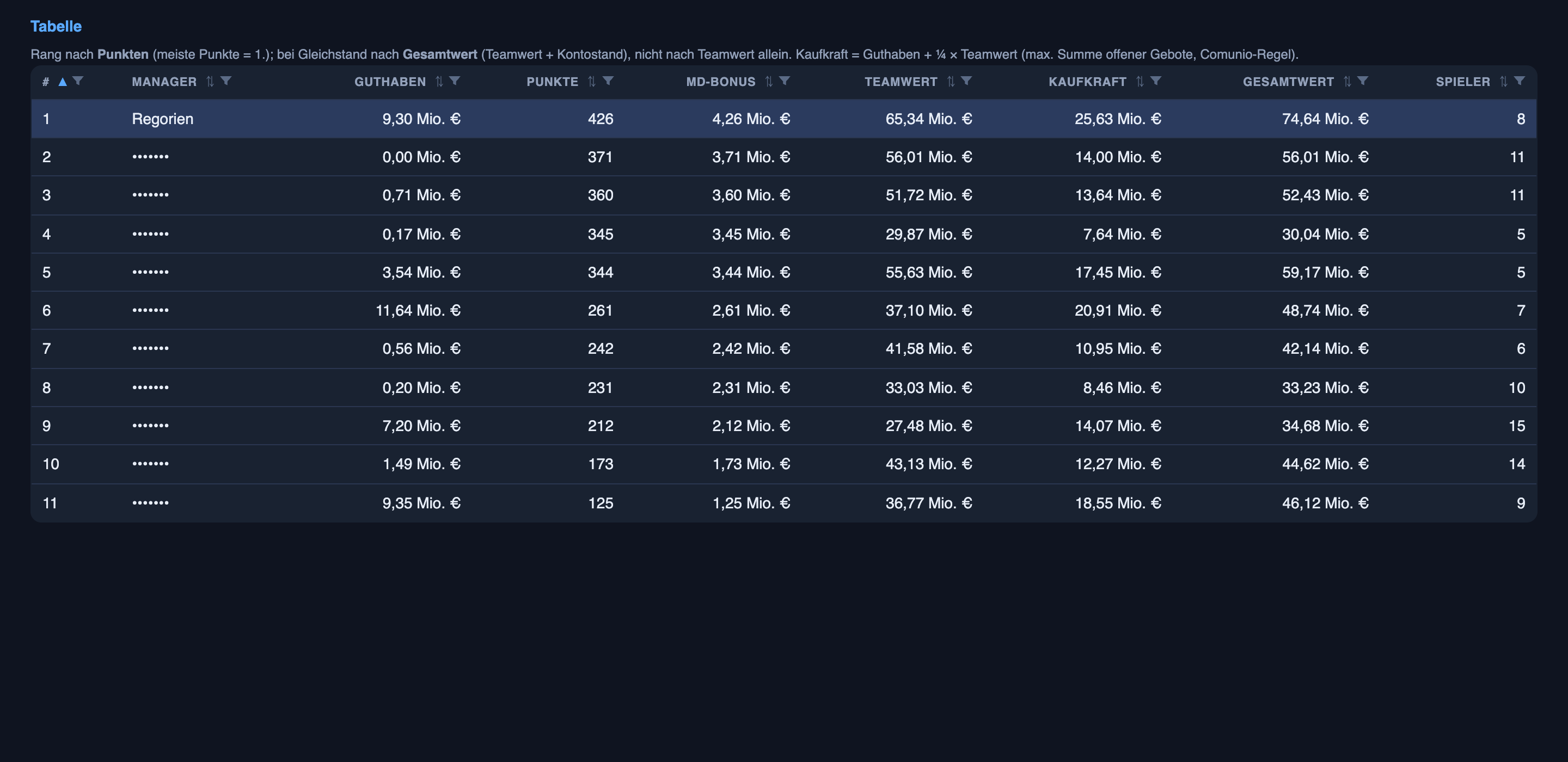
How do both things happen in the same round? Because the two halves of this system feed the league in completely different amounts. Match-result tips score a few points when they land. The real engine is players: my eight players earn points for every minute they play, every goal, every clean sheet — doubled in the knockouts — and that engine runs on the quiet half. Who to buy, who starts, who survives the round. The who-starts model had its best round, my squad is concentrated in nations that kept winning, and the knockout multiplier amplified all of it. The flashy half fell on its face in public while the half that pays the bills compounded.
I keep coming back to this because it’s the most transferable thing in the whole series: know which of your numbers pays you. If I judged this system the way it would get skimmed in a slide deck — by the headline prediction accuracy — this was the round to shut it down. By the number that actually decides the league, it was the best round it’s ever had.
What changes for the quarterfinals
The system graded its own round and set its plan; my job was to read it critically, and I mostly co-sign it. Three changes, in order of importance:
Confidence gets a top end again. The knockout cap stays for ordinary favourites — that rule is one round old and one round vindicated. But when the market prices a side at 75% or higher and a second independent source agrees and the opponent shows none of the park-the-bus warning signs, the system is now explicitly allowed — required, in fact — to say 68–78 and mean it. Discrimination needs a loud end to exist. A forecaster that has banned itself from ever being sure is just as uninformative as one that’s sure of everything.
The format check becomes physics. Winner and scoreline must agree before a tip can be recorded — enforced in code, not in a lesson file. This is the change I care most about, because it’s the one that costs literally nothing: no judgment, no tradeoff, just an assert that makes an entire category of self-inflicted wound impossible.
Coinflips stay humble, with two new edges. Draws remain a legitimate main tip — but not as a refuge against elite teams, and when two defensively strong sides meet in a knockout, a 0–0-after-extra-time script gets priced explicitly instead of wished away. And fair coinflip losses keep triggering nothing at all.
The quarterfinal bracket the system now faces: Morocco–France, Spain–Belgium, Norway–England, Argentina–Switzerland. By its own new rules, the moment one of those games shows a clear-enough favourite, you’ll finally see a loud call again — and whether it earns it.
Strip the football out
Delete the word “football” from this round and three things are left — the same three I’d stand behind in any business review.
First — every fix casts a shadow, and the shadow is shaped like the opposite mistake. The rule that stopped overconfident favourites produced a round of uniform timidity, because a system under correction finds it cheaper to be always-quiet than selectively-loud. This is not a football phenomenon. Tighten incoming inspection after one bad batch and watch deliveries stop leaving the plant on time; tighten a fraud filter after one bad payout and watch it start declining good customers. The question to ask of any new guardrail isn’t just “does it prevent the last incident?” — it’s “what does it push everything else toward?” Calibration is two-sided: the goal was never less confidence, it was confidence that matches reality in both directions.
Second — bugs migrate to wherever you stopped looking. Two rounds ago the record of what happened was dirty and the predictions were fine. I cleaned it. This round the record of what was predicted went dirty — a format inconsistency in three tips, in a place that had never once failed before. A data pipeline is only as trustworthy as its least-watched end, and the least-watched end is always the one you just finished fixing, because that’s the one you’ve stopped worrying about — the month you finally get the delivery notes reconciled is the month the errors move into how the invoices are written. The boring answer — validation at the point of writing, not the point of reading — is the same boring answer it’s been for fifty years, and it took a public 25% to make me actually implement it.
Third — a strict grader is a feature, even when it grades against you. My scorecard marked two right answers wrong this round because they were recorded in a self-contradicting format, and I let both marks stand. In any system where records trigger real consequences — a payment, a shipment, a compliance report — a correct answer written ambiguously is wrong, because the machine acting on it can’t ask what you meant. The temptation to hand-correct “what the system really meant” is exactly how a clean audit trail rots into a story you tell yourself.
The quarterfinals are next: four games, the new confidence tiers live, and a bracket where my own squad’s fate and my system’s grades are tangled together — France, Argentina, England, Spain, Morocco and Belgium all still alive, and every one of my eight players on a team still standing. The record so far says the loud half of this system is still learning to be trusted and the quiet half already is. If there’s a system on your desk whose headline number just had a terrible stretch — it might be worth checking, before you shut it down, which of its numbers actually pays you. Mine just had its best round, and you’d never know it from the scoreline — which stays on the public page at 2 of 8 all the same. You know where to find me.